Article written by Ronald Stenger; Ron shares practical insights on how fire departments can equip their teams for hazmat response readiness without overcomplicating operations.
When responding to emergencies, engine and ladder companies are frequently the first units on scene—whether it’s a fire, traffic accident, medical call, or hazardous materials (hazmat) incident.
While full-scale hazmat teams bring specialized equipment and advanced training, the initial actions taken by first-arriving units are critical to life safety, incident stabilization, and property conservation. Engine and ladder companies play a vital role in early recognition, isolation, and initial mitigation of hazmat events. Equipping these frontline units with the right tools allows personnel to safely manage the situation until a hazmat team arrives. The proper gear enhances firefighter safety, supports quick decision making, and protects the public from further harm.
This article outlines a comprehensive cache of hazmat equipment that engine or ladder companies can carry to support their role in hazmat response. Companies should follow any guidelines set forth by their departments for response.
DETECTION AND MONITORING EQUIPMENT
Early identification of hazardous substances is crucial. The following tools help responders determine the type and severity of the hazard.
- Multigas detectors (e.g., 4-gas meters): Detect oxygen levels, combustible gases (LEL), carbon monoxide, and hydrogen sulfide.
- Multigas detector with photoionization detection (PID): For volatile organic compounds (VOCs). Ninety percent of hazmat runs involve VOCs.
- Passive multigas or single gas (CO) for first-in EMS bags.
- Radiation detectors: Monitor for alpha, beta, and gamma radiation. It is possible a response could involve a company that may deal with radiation, and it could take a hazmat team a while to respond.
- pH paper/strips: Used for identifying acids or bases on for liquids.
- PH will help to determine if it is an acid or a base. A 4- or 5-gas meter can’t
detect this.
- Fluoride test paper (F Paper) used for detecting the presence of fluoride ions involving hydrofluoric acid and others.
- This paper will turn bright yellow.
- Thermal imaging camera (TIC): While mainly used for fire, TICs can detect temperature differences in hazmat spills or vapor clouds. They can also be useful for determining the amount of material in some tanks.
- Temperature gun with at least a 50:1 ratio.
- See the temperature of tanks, drums, etc.
- Determine if something is polymerizing.
- Identify rapid temperature change.
- Hazmat reference apps or books [e.g., NIOSHPocket Guide, Emergency Response Guide (ERG)]: Crucial for interpreting readings, planning response, and determining initial actions. This should be on all apparatus and medic units.
- Binoculars will assist with seeing down range. Remember the ERG: 75 feet for solids, 150 feet for liquids, and 330 feet for gas.
PERSONAL PROTECTIVE EQUIPMENT (PPE)
Engine companies should be equipped with basic levels of PPE that allow them to operate safely in a potentially hazardous environment, including the following.
- Level B/C Protection:
- Splash suits or chemical-resistant coveralls (Tychem or equivalent).
- Nitrile or chemical-resistant gloves.
- Chemical-resistant boots with steel toe and shank.
- Safety goggles or face shields.
- P100 filters or air-purifying respirators (APRs) if trained and allowed by policy.
- Self-contained breathing apparatus (SCBA): Already standard on engines but essential for any hazmat response involving unknown or toxic atmospheres.
- Turnout gear: Can provide some basic protection for some hazmat runs. Use department protocols and training.
- Chemical tape: For use with chemical gloves.
DECONTAMINATION EQUIPMENT
While engine companies won’t set up full decon lines, they can initiate emergency gross decontamination. Equipment for this includes the following.
- 5-gallon buckets or garden hoses: For quick water supply in emergencies. Garden hoses should be able to connect to the engine with the correct adapters.
- Brushes, soap, and towels: For manual decon of personnel or victims. Brushes should be soft and hard-soft for personnel and victims and hard on equipment and PPE.
- Disposable coveralls: To replace contaminated clothing or PPE after decon. If this is not an option, carry a change of uniforms while on shift.
- Plastic sheeting and tape: For isolating areas and as a barrier for decon areas.
- Decon solutions (Simple Green, Dawn, Clorox).
- Clorox can be measured out and stored for use.
- Decon pools: Can be used for decon and containment for spills, leaking gas tanks, and saddle tanks.
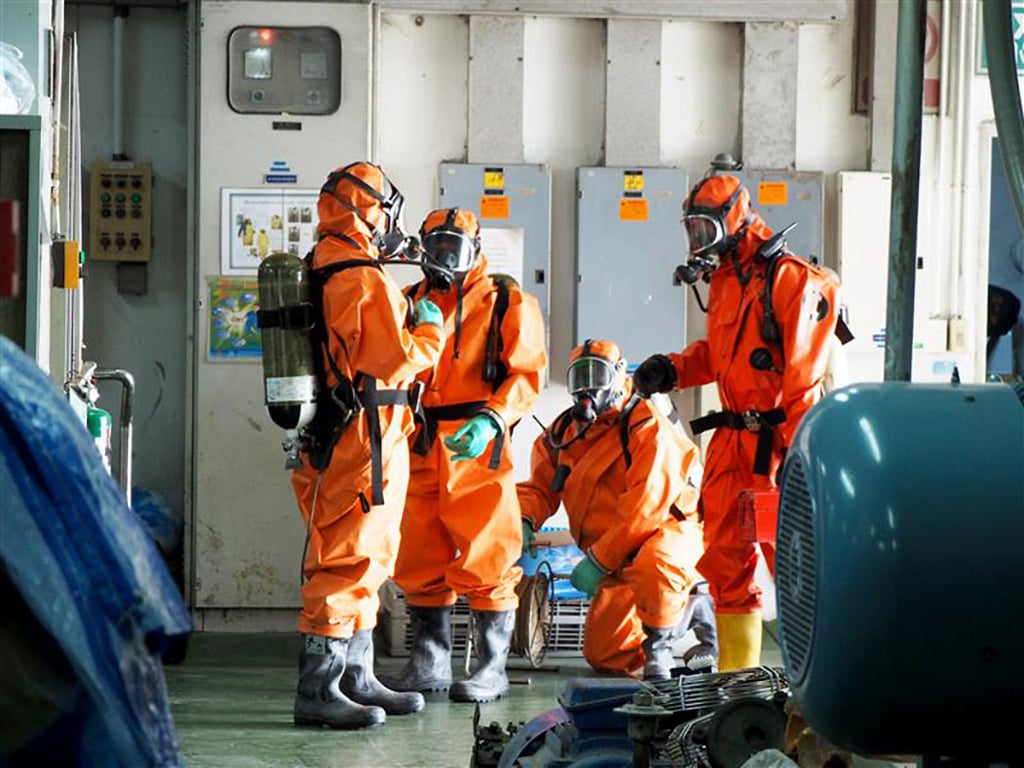
1 Photo by dear2627/ShutterStock.com.
CONTAINMENT AND SPILL CONTROL TOOLS
Engine companies may be able to contain minor spills and prevent product from spreading.
- Absorbent pads or socks (Oil-Dri, Speedy Dry): For hydrocarbon or chemical spills.
- Booms, pads, and pigs: To control runoff and isolate contaminated areas. They can get bulky for storage on apparatus- Different types include hydrocarbon, acid, polar Solvents, water-resistant. Some pads will be represented by the color of the pad. Boom and pigs are the same. Pigs are around 6 feet long. Pads are 24 inches by 24 inches.
- Plug and dike material: To seal small leaks in drums or containers.
- Putty material.
- Wood material (wedges, golf tees).
- Commercial made items.
- 5-gallon buckets: For isolating small leaking containers and for storage of equipment and supplies to be used in the emergency.
- Nonsparking tools: To reduce ignition risk during handling.
- Basic plug kit (items from any hardware store or commercial buy).
- Shovels: Round and flat shovels.
- Hazmat SKED: To remove unconscious victims.
SCENE SAFETY AND ISOLATION GEAR
Controlling the perimeter and maintaining safety are among the first steps of hazmat response. Make sure to have the following.
- Barrier tape (hazmat, danger, fire line): For cordoning off hot, warm, and cold zones.
- Traffic cones: To redirect traffic and identify the hazardous area.
DOCUMENTATION AND REPORTING TOOLS
Accurately recording readings, exposures, and decisions is essential.
- Notebooks or field worksheets: For documenting air monitoring data and incident actions.
- Camera or tablet: For photographing scenes or documenting chemical labels and placards.
- Exposure reports for personnel to use.
- Preplans of buildings and other locations that may have hazardous materials.
An engine or ladder company’s role in hazmat incidents centers on recognition, isolation, initial protection, and support for incoming specialized hazmat teams. The equipment outlined above enables firefighters to operate safely and effectively during the critical early moments of an incident— without exceeding the scope of their training or authority.
Each department should customize its hazmat equipment cache based on its unique risk profile, considering factors such as proximity to highways, rail lines, industrial zones, agricultural areas, and chemical storage facilities. Just as important, personnel must be regularly trained on the correct use of detection tools, PPE, containment materials, and decontamination procedures.
With the right preparation, gear, and situational awareness, engine and ladder companies can serve as a vital first line of defense, helping to protect life, property, and the environment until full hazmat resources arrive.
RONALD STENGER is a firefighter/ paramedic for the Colerain Township (OH) Department of Fire and EMS. He has been with the department for 29 years. He is a member of the Ohio Task Force 1 Urban Search and Rescue (OHTF-1), Hamilton County USAR (State of Ohio Strike Team), and Greater Cincinnati Regional Hazmat Team. He is also an instructor with All Safe Inc. and Cincinnati State Community College for technical rescue.